

The 90-Day Sprint: Is a CAT Crash Course Enough to Cross the 95 Percentile in 2026?
Ninety days can feel like a very short time when CAT preparation is involved. Most aspirants reach this stage with a mix of emotions. Some regret not starting earlier. Others worry about unfinished topics, low mock scores, or inconsistent study schedules.
The pressure becomes even stronger when you see friends discussing advanced concepts while you are still trying to build confidence in the basics.
The reality, however, is more encouraging than most students think.
Every year, thousands of aspirants make significant improvements during the final three months before the exam. They do not achieve this by studying every topic under the sun. They do it by following a focused CAT 2026 preparation strategy that prioritizes the activities most closely linked to percentile improvement.
A crash course can certainly help during this period, but only if it is used correctly. It should not be viewed as a shortcut or a magic solution. Instead, it should support a CAT 2026 preparation strategy built around mock tests, revision, analysis, and consistency.
Why Most CAT Aspirants Misunderstand Crash Courses
Many students join a crash course believing it will solve all their preparation problems. They expect a few months of classes to compensate for missed concepts, inconsistent preparation, or months of procrastination. Unfortunately, that expectation often creates disappointment because CAT rewards execution more than content consumption.
A crash course is not designed to teach every concept from scratch. It is designed to accelerate revision, improve exam temperament, and help students focus on the most important areas. When students expect it to replace an entire year of preparation, they usually end up overwhelmed and confused. Their CAT 2026 preparation strategy becomes reactive instead of structured.
The students who benefit the most from crash courses usually approach them differently. They already understand that their job is not to complete everything. Their job is to identify high-impact topics, improve accuracy, and maximize performance in mock tests. A crash course simply gives structure to that process.
For these students, a preparation strategy with well-structured courses becomes much easier to execute because they stop worrying about what they are not studying. Instead, they focus on what will move their score forward in the limited time available.
Who Should Avoid Depending Entirely On A Crash Course?
Not every aspirant should rely heavily on a crash course. If you have not covered any Quant fundamentals, rarely read comprehension passages, and have never attempted a full-length CAT mock test, expecting a crash course to solve everything may not be realistic. In such situations, the challenge is often conceptual understanding rather than revision.
Similarly, students who constantly switch between resources, YouTube videos, cat coaching materials, and random study plans often struggle regardless of the program they join. The problem is rarely a lack of resources. It is usually a lack of focus.
A strong CAT 2026 preparation strategy combines guided learning with disciplined self-study. Crash courses can strengthen preparation significantly, but they work best when they support an existing effort rather than replace it entirely.
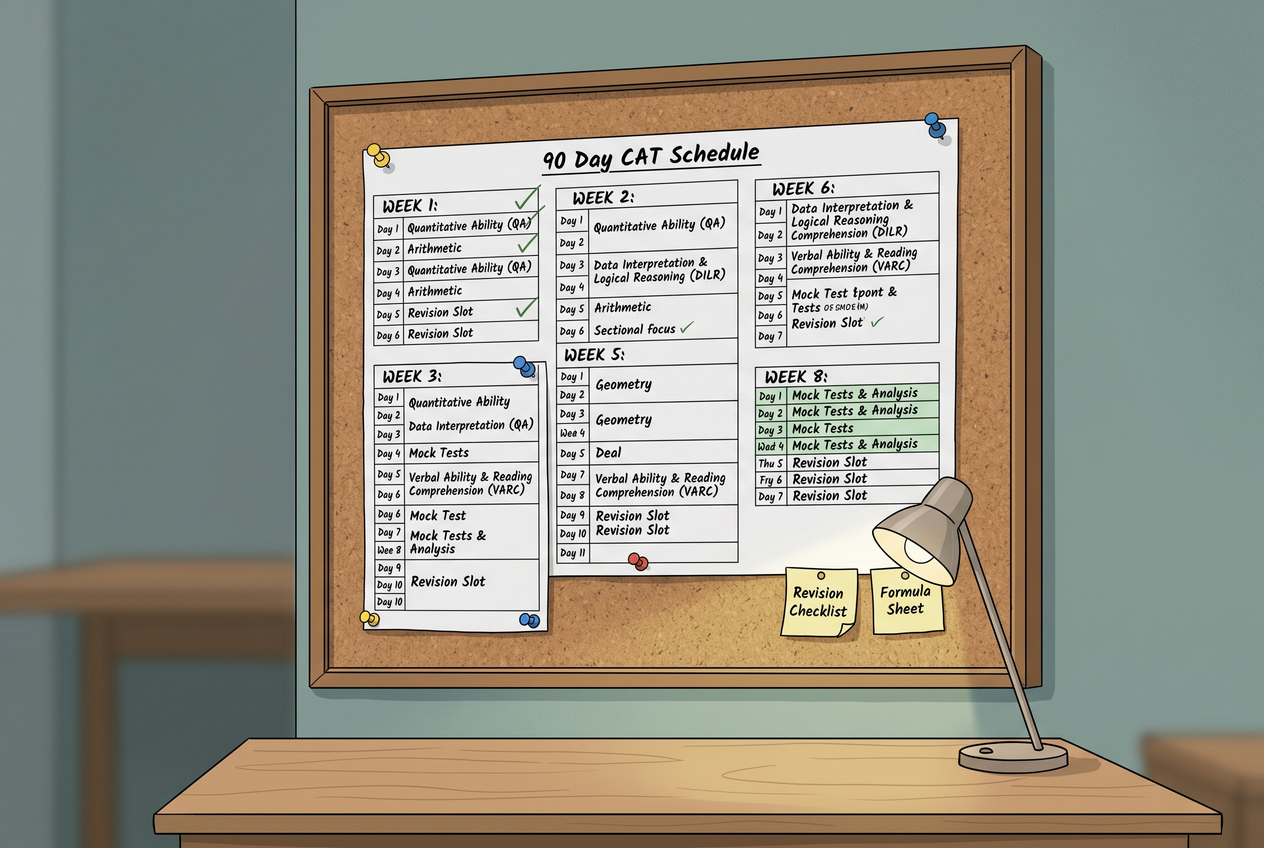
A Practical 90-Day Study Plan For CAT 2026
The biggest advantage of having 90 days is that you still have enough time to improve meaningfully. The challenge is using that time wisely. Many students either spend too much time learning new concepts or take too many mocks without building the skills needed to improve.
A balanced CAT 2026 preparation strategy divides the final three months into three distinct phases. Each phase has a different objective, and understanding those objectives helps you avoid common preparation mistakes.
Many students spend months working hard yet remain stuck below the 90th percentile ceiling because they focus on completing topics rather than improving exam performance. A structured CAT 2026 preparation strategy helps break that barrier by aligning your effort with the skills that CAT actually rewards.
The goal is not to study harder every single day. The goal is to ensure that every phase of your preparation contributes to better accuracy, smarter decision-making, and stronger performance on exam day.
Days 1-30: Build Foundations And Identify Weaknesses
The first month should focus on understanding where you currently stand. This is the time to strengthen concepts, revisit important formulas, and identify the question types that consistently trouble you.
Begin with a diagnostic CAT mock test and create an error log immediately. Every mistake should be categorized so you can identify patterns. Many students discover that the same concepts appear repeatedly in their mistakes, making targeted revision much easier.
During this phase, your CAT 2026 preparation strategy should focus heavily on arithmetic, algebra, reading comprehension, and basic DILR structures. The objective is to build confidence while removing major conceptual gaps.
Avoid chasing advanced topics during this period. Strong fundamentals create a much bigger impact than scattered knowledge across multiple chapters.
Days 31-60: Increase Accuracy And Sectional Performance
The second month is where preparation starts becoming performance-oriented. By now, you should have a reasonable understanding of your strengths and weaknesses.
This phase should include more sectional tests, timed practice sessions, and regular mock tests. Instead of learning new concepts every day, focus on improving accuracy and decision-making under pressure.
A strong CAT 2026 preparation strategy during this period involves refining your approach to questions rather than expanding your syllabus endlessly. Students often see their biggest percentile jumps during this phase because they start converting knowledge into performance.
The objective is to become more efficient. Every question should require less time, fewer mistakes, and greater confidence.
Days 61-90: Focus On Mock Tests And Exam Strategy
The final month is all about execution. At this stage, your preparation should closely resemble the actual exam experience.
Take regular mocks and solve CAT previous year papers, analyze them thoroughly, and refine your test-taking strategy. Focus on question selection, section management, and maintaining composure during difficult papers.
Many students enter the final month still trying to complete new topics. A better CAT 2026 preparation strategy focuses on maximizing strengths and minimizing avoidable mistakes. Small improvements in decision-making often produce larger score gains than learning an entirely new concept.
The final thirty days should build confidence, not panic. Trust the work you have already done and focus on performing well under exam conditions.
Common Mistakes That Stop Students From Reaching 95 Percentile
Most aspirants who miss the 95th percentile mark do not fail because they lack intelligence or resources. They usually make a few strategic mistakes that limit their progress despite putting in significant effort.
Here are some of the most common mistakes that weaken an otherwise solid CAT 2026 preparation strategy:
- Taking mocks regularly but spending very little time analyzing them.
- Constantly changing study plans after every low score.
- Focusing on low-weightage topics while ignoring core areas.
- Spending more time watching lectures than solving questions.
- Avoiding difficult sections instead of working on weaknesses.
- Comparing scores constantly with friends instead of tracking personal improvement.
- Ignoring stamina and exam temperament during preparation.
- Using too many resources simultaneously.
- Skipping revision because new content feels more productive.
- Waiting for motivation instead of following a consistent schedule.
Avoiding these mistakes can often improve results faster than discovering a new preparation technique.
How We Approach CAT Preparation For Late Starters At MBA Pathshala
At MBA Pathshala, we work with many students who begin serious preparation later than they originally planned. Some are working professionals balancing demanding schedules, while others are students who only recently decided to pursue management education.
For late starters, our focus is not on overwhelming them with content. Instead, we help them build a practical CAT 2026 preparation strategy that prioritizes high-impact activities. This includes structured revision, mock analysis, doubt-solving sessions, and regular performance reviews.
We believe that clarity is often more valuable than volume. That is why our CAT online live classes focus on helping students understand what to study, what to skip, and how to improve steadily over time.
Through guided practice, authentic mock experiences, and mentor support, we help students stay consistent during the most important phase of their preparation. For many aspirants, having a clear roadmap removes uncertainty and allows them to focus entirely on execution.
A strong CAT 2026 preparation strategy is not about studying everything. It is about doing the right things consistently, and that principle shapes how we support our students.
Explore all our CAT courses here!
FAQs On CAT Crash Courses And CAT 2026 Preparation
Can I Reach 95 Percentile With Only 90 Days Left?
Yes, many students have achieved this, but it depends on your current level, consistency, and execution. A focused CAT 2026 preparation strategy can produce significant improvements within three months when combined with disciplined practice and mock analysis.
How Many CAT Mock Tests Should I Take During The Final Three Months?
Most aspirants benefit from taking one mock per week initially and increasing the frequency during the final month. The key is not the number of tests but the quality of analysis after each test.
Are CAT Online Live Classes Necessary During The Last 90 Days?
They are not mandatory, but they can be extremely useful for maintaining consistency, clearing doubts, and staying accountable. Many students find cat online live classes particularly valuable during the final stretch.
Should I Focus More On CAT Previous Year Papers Or Mock Tests?
Both serve different purposes. CAT previous year papers help you understand actual exam trends, while mocks simulate exam conditions and help refine strategy. A balanced CAT 2026 preparation strategy includes both.
Is A CAT Crash Course Enough For Non-Engineers?
A crash course can be effective for non-engineers if they combine it with consistent practice and concept revision. The course should support preparation rather than replace individual effort.
What Is The Most Important Part Of A CAT 2026 Preparation Strategy?
Mock analysis is arguably the most important component. It identifies weaknesses, improves decision-making, and helps students refine their approach continuously throughout the preparation journey.
How Do I Choose The Best Online Coaching For CAT?
Look for programs that emphasize mentorship, mock analysis, doubt solving, and structured planning rather than simply offering more content. The best online coaching for CAT helps students execute consistently and improve steadily over time.