

Cracking CAT 2026 When You Are Weak in Math: a Survival Guide for Non-engineers
Preparing for the Common Admission Test (CAT) as a non-engineer often feels overwhelming when study materials assume a mastery of advanced mathematics. For those with a weak quantitative background, the primary challenge is identifying high-yield topics while ignoring unnecessary distractions. This guide provides a clear roadmap for CAT preparation, specifically designed for non-engineers aiming for success in 2026. This guide explains cat prep for non-engineers clearly and shows what to evaluate next.
A dormant mathematical background is not an obstacle to success in the upcoming exam cycle. Achieving a high percentile in 2026 is not about mastering complex calculus; it is about strategic focus and foundational clarity. By prioritizing core concepts over rote shortcuts, the path forward becomes practical and far less intimidating.
In this guide, you will discover how to approach CAT preparation with confidence. We will cover the signals that matter, common mistakes to avoid, and how to simplify your study plan to focus on the areas that truly impact your final score.
What Does the CAT Quant Section Actually Test? (Definition)
The Quantitative Aptitude (QA) section of the CAT exam is fundamentally a test of logic applied through basic arithmetic, not an assessment of advanced engineering mathematics. Many candidates panic, assuming the exam requires a deep technical background. However, the syllabus heavily emphasizes topics mastered by the tenth grade. The real challenge lies in how questions are framed to test analytical thinking under time pressure.
Foundational clarity is the most reliable way to navigate the notoriously tricky phrasing of the exam. The CAT Exam Pattern for 2026 demands speed, but speed is a byproduct of deeply understanding the basics rather than memorizing shortcuts. High-quality CAT Online Coaching focuses on breaking down these foundational layers. When a question twists a familiar concept, you can still identify the underlying logic. Exploring a CAT 2026 Free Preparation Course Strategy Tests Motivation Live Classes 6942b1fe3d5b9d02ec95b020 can demystify these core concepts and show you exactly what to expect.
Engineer vs. Non-engineer: the Math Background Myth (Comparison)
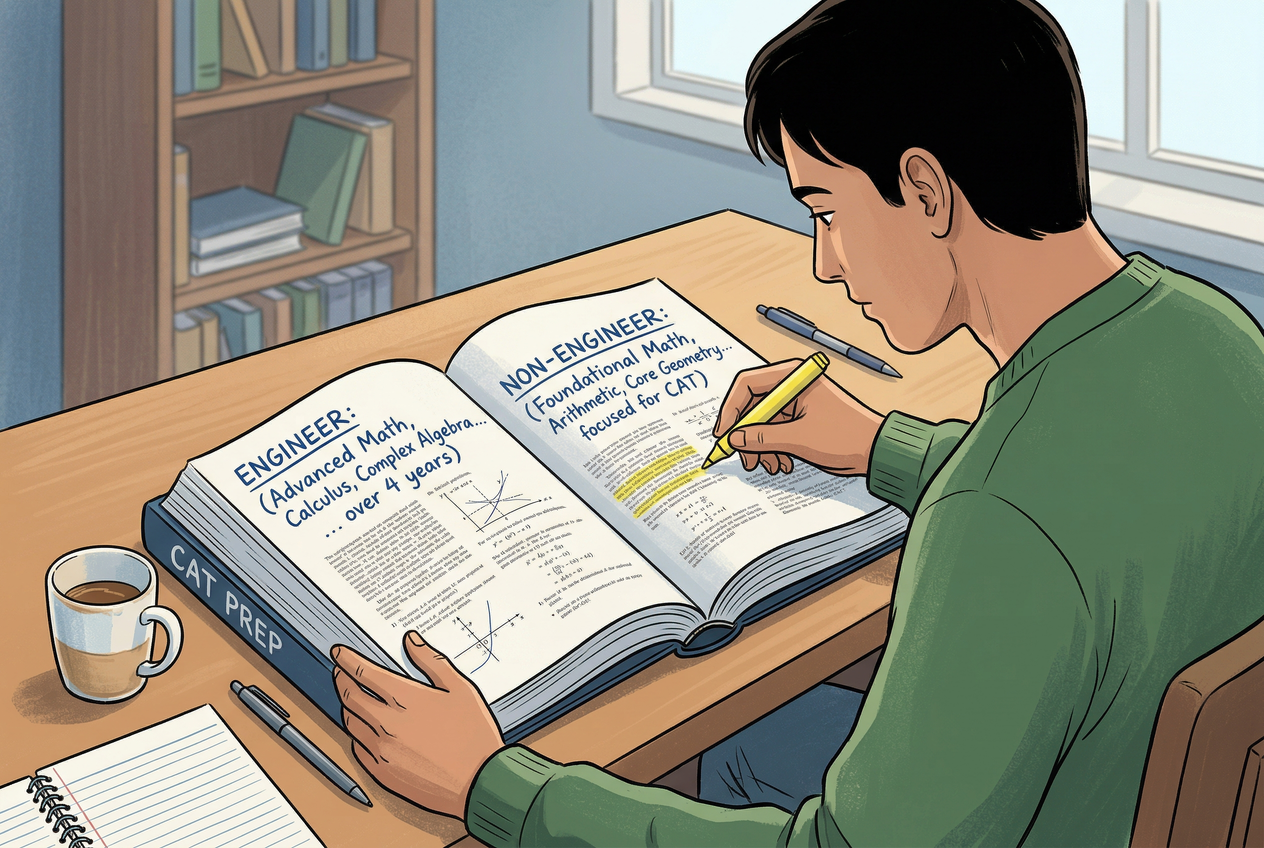
Engineers often start their CAT journey with a higher comfort level around numbers, but this early advantage can become a liability. Accustomed to complex calculus, many fall into the trap of over-relying on memorized formulas while skipping basic logic. This rigid approach often backfires when questions demand critical thinking rather than simple mechanics.
Non-engineers possess a hidden advantage in their reading comprehension skills, which are essential for decoding word-heavy quantitative problems. Instead of panicking over numbers, students from arts or commerce backgrounds can break down the language to find the underlying logic. This is why MBA Pathshala CAT coaching emphasizes conceptual clarity, allowing students to systematically dismantle problems.
- Starting Comfort: Engineers feel at ease with raw calculations, whereas non-engineers must initially overcome math anxiety.
- Problem-Solving Approach: Engineers risk forcing complex formulas onto simple problems, while non-engineers naturally lean on reading comprehension.
- Adaptability: Engineers often struggle to unlearn rigid methods, but non-engineers can build a flexible foundation from scratch.
5 Foundational Steps to Crack CAT Quant in 2026 (List-based Summary)
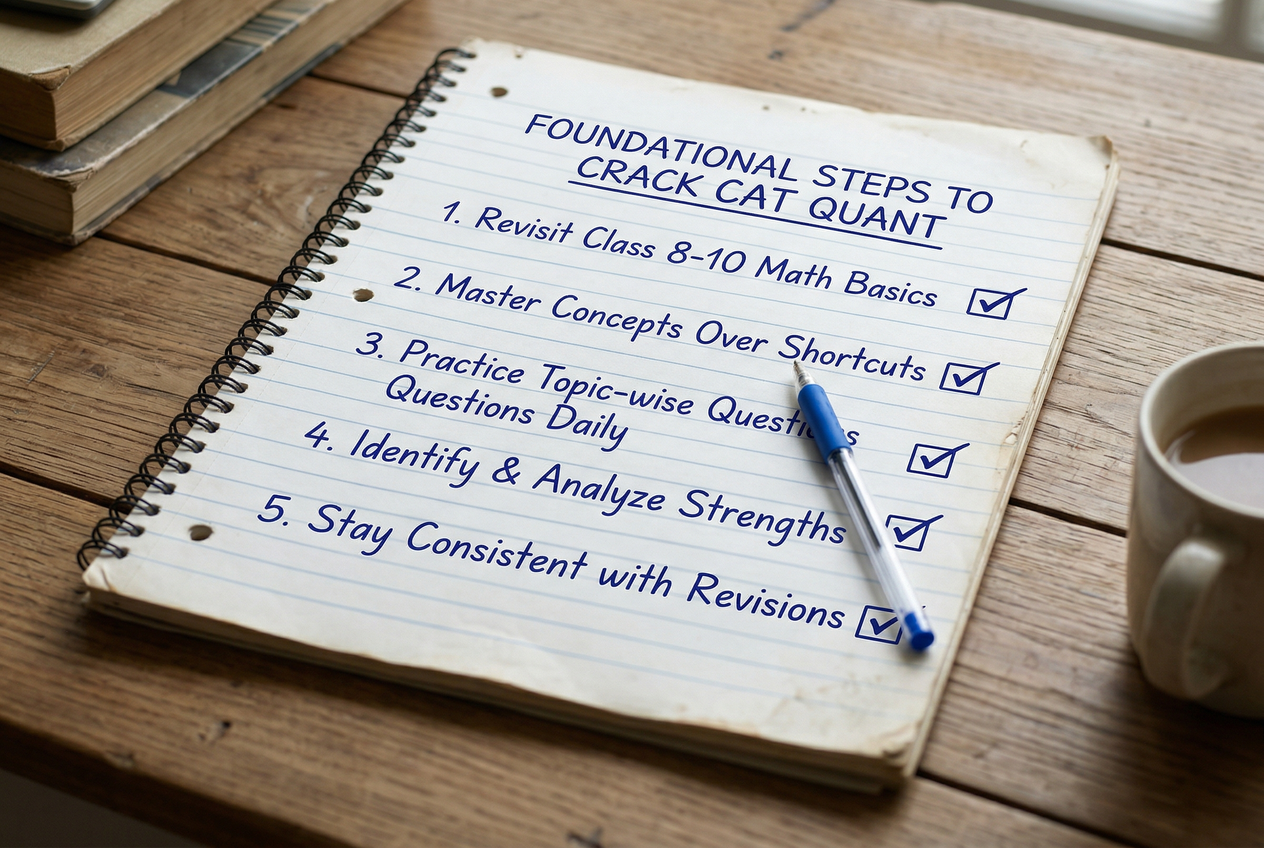
Building a reliable quantitative foundation requires a deliberate approach rather than a frantic rush through advanced topics. Historical data from the last five years of CAT papers shows that Arithmetic and Algebra consistently constitute 60-70% of the QA section, providing a clear roadmap for those avoiding advanced math. By shifting your focus toward fundamental clarity, you can systematically dismantle the quantitative section.
Executing this strategy requires a clear roadmap. Here are five foundational steps to structure your MBA Pathshala CAT 2026 journey:
- Start with Arithmetic and Algebra basics, as these carry the highest weightage and form the backbone of the section.
- Stop memorizing shortcuts and instead learn the underlying logic behind every formula to handle twisted question formats.
- Utilize structured resources to maintain momentum and track your progress effectively.
- Practice consistently with authentic, exam-level questions, actively avoiding overly difficult mocks that only serve to demotivate.
- Join a dedicated peer group like the CAT Exam Community to share insights, resolve doubts, and stay accountable.
Why Rote Memorization Fails in CAT 2026
Recent iterations of the Quantitative Aptitude section have systematically eliminated questions that rely on direct formula application. Educational experts note that the CAT 2024 paper continued the trend of rewarding conceptual depth over the rote application of formulas. A student might memorize a hundred geometry theorems, but if the question twists the premise slightly, that rigid knowledge fails under strict time constraints.
Relying on surface-level tricks creates a false sense of security. To survive this shift, non-engineers must prioritize step-by-step conceptual breakdowns over rapid-fire shortcut drills. When you understand the underlying mechanics of a mathematical concept, you can adapt to unfamiliar question structures without panicking.
- Focus on the logical derivation of formulas rather than just the final equation.
- Break down complex word problems into smaller, manageable arithmetic steps.
How Udit Sir’s Quant Batches Bridge the Gap
Overcoming a weak quantitative background requires a mentor who understands the specific hurdles non-engineers face. Udit Sir anchors his teaching philosophy on eliminating JEE-level fluff, ensuring that students only focus on what the exam actually tests. Instead of overwhelming learners with complex calculus, his curriculum breaks down arithmetic and algebra into digestible concepts.
Transitioning from foundational clarity to exam readiness requires structured learning and consistent practice. Enrolling in the dedicated CAT 2026 BATCHES provides the exact roadmap needed to navigate this journey without burnout. This systematic approach to Quantitative Aptitude yields tangible results for students who haven't touched math since high school.
- Focuses strictly on core Arithmetic and Algebra fundamentals.
- Removes intimidating, high-level engineering mathematics.
- Provides a structured roadmap tailored for non-engineers.
Strategic CAT Preparation for Non-engineers
Preparing for the CAT as a non-engineer requires a shift in mindset. Instead of viewing math as a series of complex equations, treat it as a language of logic. By focusing on the "why" behind every solution, you can bridge the gap between your current skills and the requirements of top-tier IIMs (Indian Institutes of Management). Success is a result of consistent, targeted practice rather than innate mathematical genius.
Related Search Angles
Readers evaluating this topic also tend to search for:
- Best CAT Online Coaching
- CAT Preparation
- CAT 2026 Preparation
- CAT 2026 Coaching
- CAT 2026 Online Preparation
- MBA Pathshala’s CAT 2026 Preparation
- CAT Prep by MBA Pathshala
- CAT Exam Syllabus
- CAT Exam 2026 Information
- CAT Exam Details
- CAT Details YouTube
- Best CAT coaching online for 2026
- How to prepare for CAT 2026
- CAT 2026 preparation strategy
- CAT syllabus and exam pattern 2026
CAT Prep for Non-engineers
Preparing for the Common Admission Test (CAT) as a non-engineer can feel unnecessarily daunting when every resource offers conflicting advice. For those with a weak quantitative background, the primary hurdle is identif…
FAQ
What Is the Most Effective Approach to CAT Prep for Non-engineers Who Struggle With Math?
The most effective approach is prioritizing foundational clarity over rote shortcut memorization. Start by mastering basic Arithmetic and Algebra before moving to advanced topics. MBA Pathshala focuses strictly on what the CAT actually tests, eliminating unnecessary JEE-level fluff.
Can I Score a 99th Percentile in the CAT Quant Section If I Haven't Studied Math Since 10th Grade?
Yes, absolutely. A weak math background is not a dealbreaker. The CAT tests logical application of basic mathematical concepts, not higher-level engineering mathematics. By following step-by-step conceptual breakdowns, many non-engineers have successfully bridged this gap.
How Does MBA Pathshala Differ From Other CAT Coaching Institutes for Quantitative Aptitude?
MBA Pathshala is specifically tailored for students who need to rebuild their math fundamentals from scratch. While other institutes often rush through basics or rely on complex formulas, Udit Sir provides step-by-step conceptual breakdowns, keeping your preparation highly relevant and practical.
Which Math Topics Should Non-engineers Prioritize for the CAT Exam?
Non-engineers should heavily prioritize Arithmetic and basic Algebra. These two areas consistently make up the largest portion of the CAT Quant section. Mastering percentages, ratios, profit and loss, and linear equations will yield the highest return on your study time.
Will Memorizing Shortcuts Help Me Clear the CAT Quant Sectional Cutoff?
Relying solely on shortcuts is a dangerous strategy for the CAT. The exam is designed to test your core understanding, and questions are often framed to penalize blind formula application. Building foundational clarity allows you to adapt to twisted questions.
When Should I Start Taking Mock Tests If My Math Fundamentals Are Weak?
You should begin taking mock tests only after completing the foundational syllabus for Arithmetic and Algebra. Attempting full-length mocks too early can severely damage your confidence. Focus on topic-wise tests first to solidify your concepts, then transition to comprehensive mocks.
Next Step
Enroll in Udit Sir's Quant Batch. Use the points above to pressure-test your fit, clarify trade-offs, and move toward your next step with more confidence and less guesswork.